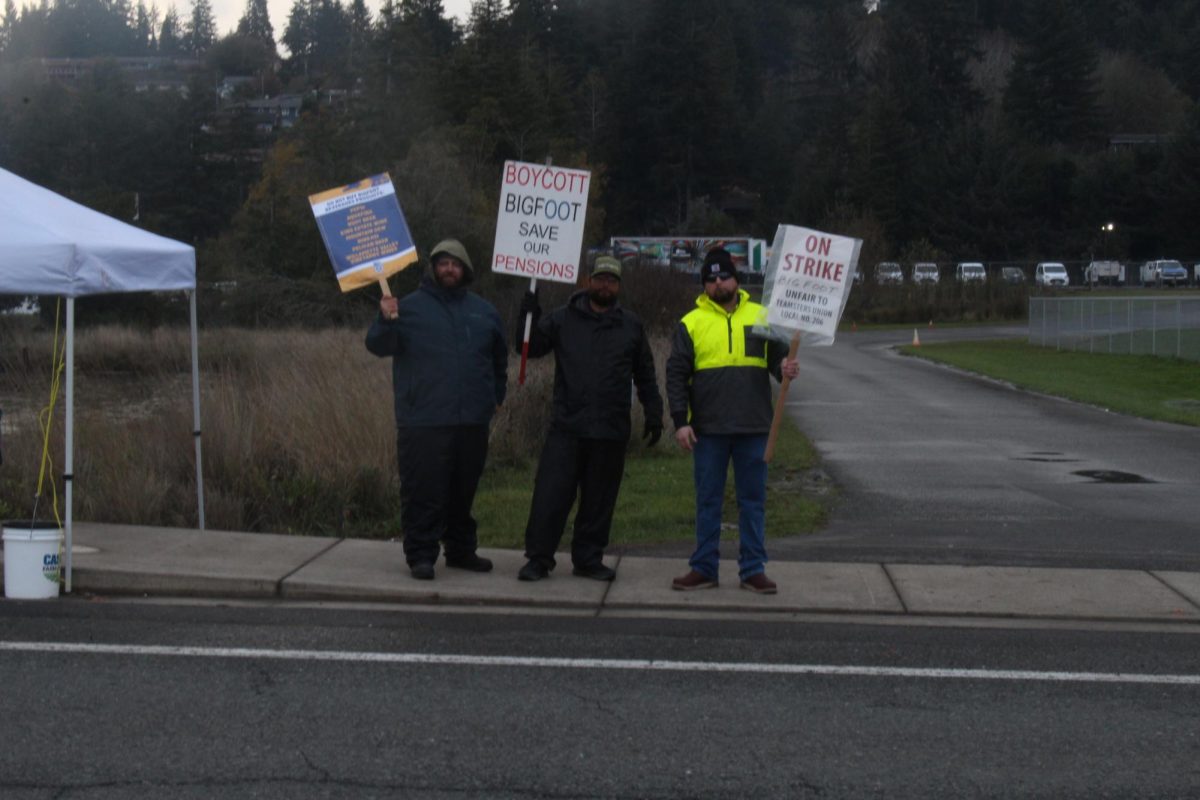




Starting on June 14th-Donald Trump’s 79th birthday and 250th anniversary army parade, began the ongoing no kings protests; a wave of demonstrations started by a series of individuals and coalitions claiming to be against authority figure corruption and have the intent to stop those believed to pursue dictatorship or tyranny. The largest scale of no king’s protest hitherto describes the event that took place on October 18th this year, protesting against Trump with an estimated forty to fifty thousand people marching in downtown Portland after gathering in Waterfront Park, which led to the closure of Southwest Naito Parkway for the majority.
On this day, there were also many satellite protests, which were focused on the ice facility (about 200-500) in addition to the general city. Furthermore, there was a mass deportation of those stated as illegal immigrants, deploying 2000 National Guard and 700 Marines dispatched by the Pentagon after being authorized by the president to which was enforced by ICE in Los Angeles. For this reason, a large number of protests arose, which mainly took place in Portland, for the Oregon state due to being the largest and most populous city primarily.
At 4:30 on the 18th, tear gas and smoke bombs were deployed on the crowd from the ICE facility, followed by tear gas, flash bangs, and pepper balls in an attempt to clear the streets. The event met with a conclusion as it began to rain, and three people were arrested for bias crime, assault, and harassment charge(s). In accordance with these events there was an ‘emergency’ protest against the possibility of national guard troops being deployed along with the rise of inflatable related ice protesting started by seth todd, who had gained fame online due to dancing around the ice facility in a frog costume which -with one side recounting it was peaceful and the other claiming contrarily- led to him being pepper sprayed to which the response was many people joining in inflatable costumes.
Regarding the events in Portland, Don R.- a 3 year racecar engineer whose workplace is next door from the ice facility protests states “protests started about May, probably about until June or July, until they started using pepper balls and tear gas, about June, July, something like that.” and “They haven’t really used any pepper balls since it started raining again.” When asked about previous events, R. states, “We were trying to get a transmission back into an RX-7. And our buddy turns around to go grab something. He looks over, and we just get big green clouds wafting in here. We stop, and we stare at it. We’re like, Oh, that’s not good. Then we went to put the transmission back in, and about 45 seconds later, it hit us, and it hit us hard. I mean, we all just dipped out through the back door there, and our buddy totally ate it and tripped because his vision went out from all the tear gas. And then I tried to go back and help him, but it was like it was just too much. But finally, this smart guy (Andrew C.-a mechanical engineer who works with R.), because he got the glasses, he’s not immediately affected by the eye part. So he ran back and grabbed some respirators and gas masks. And then we all booked it in the back, and I got an old Chrysler out there that’s like a sealed chamber. So we all just jumped in there. It was definitely, definitely, probably the worst. It was the worst one… I had to pay a lot of that stuff out of my own pocket. Fortunately, you know, we had some pretty big jobs beforehand, so we had some money to like, float along for sure. But you know, it only lasts so long, and you get bills and everything.”
Among these subjects, C. states, “5 minutes of just trying to breathe again. And then we got out, and it was still in the air. And then the shop was completely still filled. And it took about 30 minutes for the shop to air out. And then the worst part of that is it comes back if you take a shower later. So you clean it all off yourself. And then it’s like, oh god, yeah, that was definitely the worst one. Yeah, that was definitely the worst one.” along with “Like, the chemical burn, which is unpleasant, that’s mainly what has affected us when they use it, that is. But a lot of times it’s at night, so we’re not here.”
- says “between the protesters constantly occupying our corners, so we can’t park our vehicles here. We had to postpone a lot of customers for a couple of months. They’re constantly aggravated at something just because we exist. We’ve had death threats, arson threats, and then on top of that, because of their constant assault on the ice. The ice building has to use some sort of non-lethal something, like tear gas or pepper balls. And a lot of that stuff will end up drafting in through our door. So most surfaces in here, if you blow on them, you’ll get a nice big hit of pepper balls. When the protests get really bad, we’ve gotten tear gas out of the shop now three times. So yeah, we’ve been affected by it pretty decently. There were about two months when we couldn’t bring any cars into the shop. We had to postpone people. We’d have a hard time even getting down here to work longer than about an hour on weekends. Yeah, you just start getting hit by the pepper ball stuff. That’s the worst stuff. The tear gas isn’t even that bad. It’s pepper balls because they just linger. You cough a lot, you sneeze a lot, and it’s almost like having allergies, but like, times 10, so it’s just terrible.”
Among recent protests, alias Jay Heathers- the group protest organizer- states, “In the first part of it, there was so much brutality, like a lot of gassing, a lot of shooting pepper balls and rubber bullets at people, and they were specifically with the gas. They were doing that for months and months, so badly that the preschool here had to relocate completely. All of the civilians in the neighborhood were complaining about their lungs, and even people who had asthma just got worse and worse. Obviously, the ecosystem is affected by that kind of stuff as well. Some women actually experienced miscarriages because tear gas is very bad for hormones, and so it can affect your reproductive system in general. So, and then after that, there was a little period where it was kind of calmer, and only a certain group of maybe 20 or more people kept holding it down continuously. And then, more recently, there was kind of a boom again, where everyone kind of got involved. So it has its own ways. You know, it’s not going to be like a constant upwards motion in that way. But yeah, I think people who have come more recently haven’t really understood, like, how bad it used to be. But yeah, I’d say that’s kind of an answer.”
In an additional statement, Heather said, “I think we all have a very similar reason, which is we’re seeing a lot of atrocities being committed and just coming together and fighting against this. Specifically, there are people who just want to uphold even just the Constitution and basic rights that should be granted to all people, no matter what their legal status is. And unfortunately, ICE has not been operating in a way that has respected that, and they have been abducting people who are even going to their meetings, not just avoiding that. They’re doing everything in their process correctly, so as a short version of it, but yeah, I think just a moral obligation would be the short answer.” To protest continued after the interview.
Remington Walker, a former 13 Juliette in the Kansas Army National Guard for six years, states, “the goal of the military when at protests is more to just keep the peace and prevent anything from happening. We always use non-lethal force. However, it’s pretty standard for the military to always be armed with lethal force… The military always wants to avoid showing power or strength towards citizens. It’s not our goal to show force towards citizens.”
When asked about strategies and how they learn to handle protests, Walker said. “It ranges all over the place. So, when I was in the National Guard. It was a little bit of training every year over those six years. We didn’t have any specific lock of training where it was just over how to respond to things like protests. But I remember the first little bit of training that we did was just a lecture. So we just sat in front of a few different speakers, also in the military, who had responded to things like protests. And the thing that they kept repeating over and over is that we’re just there to keep the peace. So when you are responding. And you have orders to go be stationed out of protest. The role is to just keep the peace. It’s not to side with either side of the protest for or against. So you’re to stay completely unbiased and not show your opinion while you’re there. It’s to de-escalate the situation. And then if the situation does escalate to the point where you have to use force, it’s to use as little force as possible to de-escalate.”
In light of these events the protesters shined green lasers at helicopters near the ice facility, Bob Mortenson, a pediatric and neonatal flight nurse says “They gave us four days’ notice that they were going to be shining lasers all night long into the sky because of the ice helicopters and the protesters know that it’s an effective way to get us out of the air, because we can’t fly when we’re in the helicopters because the lasers will blind us, especially with our night vision goggles on. So to get the ice helicopters out of there, they just started shining lasers at anybody who flew over. It affected us because the ice building is right at the base of the hospital, right at the bottom of the hill. So they weren’t, you know, caring about what kind of helicopter it was, so I don’t think they could tell the difference. But they had made it known to the public they were going to do this.”
In reflection of the events, Mortensen also says, “I wasn’t on shift, but one of our pilots had tried to fly in there, and he got lasered up pretty big, so he had to turn around. So the hospital just shut it down and said for those three or four days that they were going to be shining lasers all night long. We weren’t allowed to fly into the hospital at all. I travel all around the state of Oregon for critically ill or injured children, or high-risk deliveries, like neonates. We use a helicopter, an airplane, and an ambulance, depending on weather and distance, how far we have to go, because in the state of Oregon, there are only two pediatric ICUs, and they’re both here in Portland. So any kid anywhere in the state that gets critically injured and needs an ICU level of care has to come here, so my job is to fly down and stabilize them and then bring them back to OHSU. So how it affected us is, for those four days, we weren’t able to fly directly to the hospital, so it significantly impacted our patients, because instead of being able to fly them right to the rooftop of the hospital and get them into the care that they needed, we had to fly to either Hillsborough airport or Aurora airport, which is where I’m working tonight, land there and then load our patients into an ambulance and then drive 20 to 30 minutes into the hospital. So it just added time to getting the patients to the hospital and to the care that they needed.”
Within this quote, Mortensen is referencing December 2nd, and in the direction of these comments,
“I think in a perfect situation, there would definitely be protests. I think everybody has the right to protest in America, and I think that’s a right that needs to be honored, whether we agree with or disagree with the protest I am. But I think things have to happen from both sides. So in a perfect protest, the protesters would all stay nonviolent, even if they, too, you know, they’re passionate about it. But nonviolence is always the way to protest. And then from the other side of law enforcement or military, the perfect world, they wouldn’t have to enforce or de-escalate. They would just be there to make sure that everybody stays safe,” said Walker.
“I think everyone has their own way about, like, how they found out it was mostly just, like, word of mouth and other people, you know, talking about it and saying that there was, you know, commotion going on, and the more you witness the brutality with your own eyes, it kind of radicalizes you, and it makes you want to get involved more and more to, you know, fight for people, to fight for yourselves and fight against a system that is not not supporting people, it’s supporting just the government and what they want, you know,” said Heathers. “Everyone should do their own research, and, you know, not listen to the news blindly, because it’s not always going to show exactly what’s going on. And you’re doing it right now, you know, you’re coming on the ground and getting a first-hand account of, you know, people’s experiences. So I feel like that’s the best way to do some sort of journalism, is to ask around and get involved with people who have seen it with their own eyes, and not just someone who’s yelling, Oh, it’s a war zone, you know, that type of thing.”